What I Measure - for RJ
RJ had asked me about all the things I measure.
I'm a bit hesitant, because I'm quite a bit of a data freak. I'm definitely NOT suggesting that others do this. It's just something that works for me, and perhaps me alone.
Daily measurements:
============
Weight
Fat Percentage
Resting Pulse
Blood Pressure
Calories from food & drink
Macronutrients - fat, carb, protein, alcohol, vitamins, etc.
Exercise Calories
Surplus or Deficit Calories
Food Quality (subjective judgement, scale of 1 to 5, 5=best)
Weight Day Measurements
================
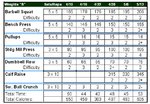
Reps & sets for each exercise
Weight
Degree of Difficulty (subjective judgement, scale of 1 to 4, 4=failure)
Time for session
Calories expended
Cardio Day Measurements
=================
Time for session
Maximum HR attained
Average HR attained
Intervals & HIIT - speed, level, resistance, HR on all intervals
Weekly Measurements:
==============
Abs (at belly button) in inches
Waist, at narrowest point
Chest
Neck
Biceps
Forearm
Thigh
Calves
Toes [just kidding, wanted to see if you're still reading

]
Monthly Measurements:
===============
Weight Loss/Gain
Change in Fat Percentage
Averages for all the above daily measurements
How Do I Keep Track?
==============
Actually, it's not as difficult as it might seem, and takes less than 10 minutes a day. I use FitDay to track all my food intake. I've set up a lot of custom meals -- stuff that I eat very frequently -- so recording calories takes just a few minutes a day. The hard part is when we go to a new restaurant, and there are ingredients I'm not familiar with.
The rest of the measurements are recorded on an Excel spreadsheet. I have a typical morning ritual: get my weight on my Tanita scale, take my blood pressure and resting pulse, and then measure my body fat with my Omron monitor. Review my results for the previous day. Record the results and write up my journal entry for the day, which I also store in FitDay (you never know what can happen with a web site).
All of this takes about 10 minutes.
I've got my spreadsheet set up so it automatically calculates surplus/deficit calories, once I put in calories for exercise and food/drink. I do this by naming a cell "NARM", which contains the current number of calories per pound of body weight for my normal activity rate of metabolism. Currently that number is 10.0. This way, as I lose weight, my NARM is recalculated automatically.
Averages and totals for the month are also calculated automatically after each entry, as are all of my fancy graphs.
After each workout, I spend a couple of minutes recording the results. Again, everything is set up in a spreadsheet, so it's no big deal.
At the end of each month, I review all the results, compare them to my goals set on the first day of the month, and formulate new goals. As you may have seen, I tend to have a LOT of goals, and it's fairly typical that I fail on some of them. The nice thing is, though, that I succeed on a lot of them too, so it's not an "all or nothing" result.
I use a couple of very subjective scales which have turned out to be quite useful or me. One is food quality, on a scale of 1 to 5. If all my macronutrients are in order, I give it a "5". This is rare. That would mean nothing junky at all the whole day, at least 175 gm of protein, and low levels of saturated fat. There are only about 5 days in the month that rate a "5". If I've had a minor transgression on the macronutrient side, I give it a "4". This could be from eating higher fat meat, or a bad carb/protein ratio. If I have anything like a cookie, even one, I automatically rate it a "3". My average score for last month was 3.4 and my average for this month is 3.6, so you can see about where things end up. If I have something like fried food, or a bigger dessert, I give it a "2". And if I just lose control, the day gets a "1". The last "1" day I had was on January 26th, when I ate gobs of fried food and ended up with a 1200 calorie surplus for the day.
The other subjective scale I use is for degree of difficulty in weights. If the weight is just too easy, I give it a 1. If it's just about right, I give it a 2. If I'm struggling on the last set, I give it a 3. And if I fail on the last set, it's a 4. If I rate something a 1, or have a couple of 2's in a row, I increase the weight. It helps me, because otherwise I forget how fatigued I was on a particular exercise, and that way I only increase the weight when I'm ready for it.
This is not to say that the "non-subjective" measurements are totally objective. Every measurement has a degree of "noise" in it -- no matter how accurate the instrument doing the measurement. Take your blood pressure three different times, and you'll get three different readings, sometimes very different. On top of that, your body fluctuates from day to day. That's why trends are really what's important. However, the more individual data points you have, the more you can rely on the trend, at least that's usually the case.
More than you ever wanted to know, right?
Let me reiterate -- this is a system that works for ME. It probably would drive most people absolutely bonkers. In my previous 8 failures, I kept track of nothing. I scoffed at this sort of stuff. But ultimately, I failed. I can't say it was because I didn't measure things. This time around, though, measurements are certainly an important part of my arsenal.