 Français
 Deutsch
 Español
 Fitness

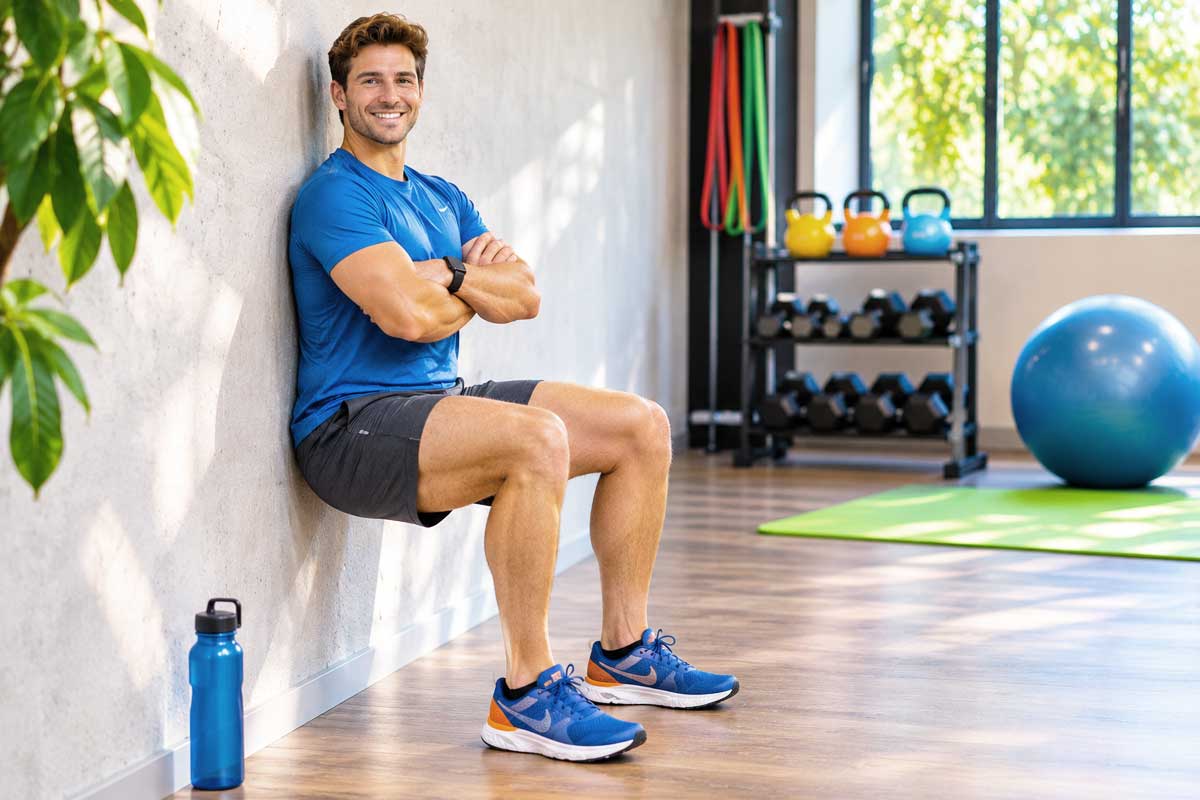
What if one of the most effective exercises for lowering blood pressure required no treadmill, no expensive equipment and almost no movement? Simply lean against a wall, bend your knees and hold the position. It sounds too simple to compete with running, cycling or traditional strength training. Yet a major scientific analysis involving 270 randomized controlled trials produced a surprising result: isometric exercise, including wall sits, was associated with greater average reductions in resting blood pressure than several familiar forms of training. The finding challenges the assumption that cardiovascular health always requires continuous movement and an elevated heart rate. But before anyone replaces their daily walk with two minutes against a wall, there are important questions to answer. How strong is the evidence? How often must the exercise be performed? And does a larger average reduction in blood pressure really mean wall sits are better than cardio?
The Surprising Results From 270 Randomized Trials
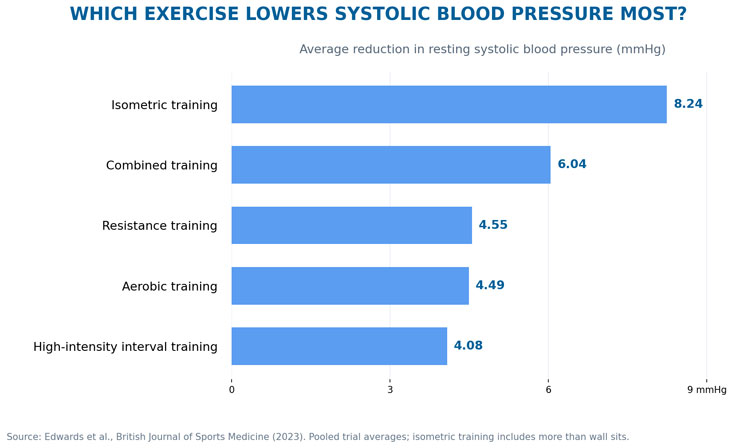
In 2023, researchers led by Jamie J. Edwards published a large-scale systematic review and network meta-analysis in the British Journal of Sports Medicine. The analysis included 270 randomized controlled trials involving 15,827 participants. Researchers compared the effects of aerobic exercise, dynamic resistance training, combined training, high-intensity interval training and isometric exercise on resting blood pressure. All five categories produced statistically significant improvements. However, isometric training showed the largest average reduction: 8.24 mmHg in systolic blood pressure and 4.00 mmHg in diastolic blood pressure. Aerobic exercise, by comparison, was associated with average reductions of 4.49 and 2.53 mmHg. The researchers also identified wall squats as particularly promising for reducing systolic pressure. The full findings are available in the meta-analysis of 270 randomized exercise trials. These results are impressive, but they require careful interpretation because the studies differed in their participants, training protocols and duration.
What Exactly Is Isometric Exercise?
Isometric exercise involves producing muscular force without significant movement at the joint. During a wall sit, the quadriceps and other lower-body muscles work continuously to maintain a fixed position. Unlike conventional squats, there is no repeated lowering and rising. Other examples include planks and sustained handgrip contractions. The apparent simplicity can be deceptive. Holding a demanding position for two minutes may become surprisingly uncomfortable as muscular fatigue develops. Isometric exercise also creates substantial cardiovascular responses during the contraction, including temporary increases in blood pressure. The long-term reduction in resting pressure is therefore not the same as the immediate response during exercise. Researchers are investigating how repeated isometric training influences vascular function, peripheral resistance and blood pressure regulation. The mechanisms are not yet completely understood, and different isometric exercises may produce different adaptations.
A Wall-Sit Trial Found a 12.9 mmHg Reduction
The evidence extends beyond the large meta-analysis. A randomized multicenter trial published in the Journal of Clinical Hypertension in 2023 studied 77 adults with elevated systolic blood pressure who were not taking antihypertensive medication. Participants were assigned to wall-squat training, isometric handgrip training or a control group. During the first twelve weeks, the exercise groups trained three times weekly. Average systolic blood pressure fell by 12.9 mmHg in the wall-squat group and 11.2 mmHg in the handgrip group, compared with just 0.4 mmHg in controls. A subsequent twelve-week phase examined whether the benefits could be maintained with only one weekly session. The results were encouraging, although the relatively small study cannot establish that everyone will experience reductions of this magnitude. Importantly, these were structured training programs conducted over months, not isolated two-minute challenges performed whenever someone remembered.
Why Two Minutes Are Not the Whole Story
The headline-friendly phrase two-minute wall sit can create a misleading impression. In several research protocols, participants performed four two-minute contractions, separated by approximately two-minute recovery periods, three times per week. That means eight minutes of actual muscular work per session, plus rest periods. The intensity was also controlled or individualized rather than chosen arbitrarily. A person attempting one casual wall sit every Sunday is not following the intervention tested in those studies. Nor should an untrained beginner immediately attempt the most demanding position possible. A sensible introduction involves learning the movement, selecting a manageable knee angle, maintaining steady breathing and gradually building tolerance. People with diagnosed hypertension, cardiovascular disease or other relevant medical conditions should discuss demanding isometric exercise with their healthcare professional before adopting an intensive protocol.
Can Wall Sits Really Beat Running or Cycling?
The most important scientific qualification concerns what the comparison actually demonstrates. A network meta-analysis combines direct and indirect evidence across multiple studies. It can estimate the relative effectiveness of different interventions, but it is not equivalent to placing thousands of comparable participants into one enormous experiment where everyone follows an identical protocol. Differences in baseline blood pressure, age, medication use, training intensity and study design may influence the results. Isometric training ranked highest for reducing resting systolic pressure in this analysis, but that does not establish that wall sits are superior to running for cardiovascular health overall. Aerobic exercise improves cardiorespiratory fitness and offers benefits that a static contraction cannot fully reproduce. Strength training supports muscle function and physical independence. Choosing an exercise program solely from one blood pressure ranking would ignore these broader adaptations.
What Happens to Blood Pressure While You Hold the Position?
There is an apparent paradox. Isometric training can reduce resting blood pressure over time, yet blood pressure may rise substantially while a demanding contraction is being held. Muscular compression of blood vessels and the cardiovascular response to sustained effort contribute to this temporary increase. Holding the breath or straining excessively can amplify the response. This is why wall sits should not be promoted as a universally harmless exercise simply because they require no equipment. Individuals with uncontrolled hypertension or significant cardiovascular disease need particular caution. The training studies involved defined protocols and participant screening, conditions that may not be reproduced in a home workout. Anyone experiencing chest pain, dizziness or unusual breathlessness during exercise should stop and seek appropriate medical assessment. A promising intervention is not automatically suitable for every person at every intensity.
How Would You Know Whether Wall Sits Are Working?
Blood pressure changes from day to day and even from minute to minute. Stress, sleep, caffeine, recent exercise and measurement technique can influence an individual reading. Someone starting an exercise program should therefore avoid drawing conclusions from one unusually favorable result. Home blood pressure monitoring can provide a more useful picture when measurements are taken consistently under comparable resting conditions. Our Fitness.com article Blood Pressure Monitors...and Why Every Home Should Own One explains why regular measurements deserve a place in preventive health care. For someone already taking blood pressure medication, improvements in home readings should be discussed with a clinician rather than used as a reason to change treatment independently. The objective is a sustained improvement in cardiovascular risk, not winning a competition for the lowest number after a workout.
Should Older Adults Add Wall Sits to Their Training?
Wall sits may offer an accessible option because they require little space and no specialized equipment. But accessibility does not mean they are easy for everyone. Knee discomfort, reduced lower-body strength, balance limitations or difficulty rising from a low position can make sustained wall squats unsuitable. A shallower position or another appropriately selected exercise may be more realistic, although it should not be assumed to reproduce the exact research results. For older adults, the broader goal remains preserving cardiovascular health, strength and functional independence. Walking, cycling, progressive resistance training and balance exercises all contribute to that objective. Isometric training may be a useful addition, particularly for individuals interested in blood pressure management, but it should complement rather than displace the activities that maintain endurance and mobility.
The Bigger Lesson: Small Exercises Can Produce Serious Adaptations
The wall-sit research challenges an assumption that remains common in fitness culture: an exercise must involve extensive movement, complicated equipment or exhaustion to produce meaningful physiological benefits. Sustained muscular contractions can influence blood pressure regulation, even when the body appears almost motionless. But the evidence also demonstrates why scientific findings need context. The 8.24 mmHg average reduction belongs to the broader isometric-training category, while the particularly strong wall-squat results come from smaller, more specific studies. Neither finding proves that two minutes against a wall can replace cardiovascular exercise, prescribed medication or a comprehensive health strategy. The most sensible conclusion is more interesting than the exaggerated promise. Wall sits may be a valuable, time-efficient addition to an established exercise routine. For people who already walk, cycle or lift weights, they offer another potentially useful training stimulus. Sometimes progress does not require doing more of everything. It requires understanding what different exercises actually accomplish.
Scientific Sources
Edwards JJ, Deenmamode AHP, Griffiths M, et al. Exercise training and resting blood pressure: a large-scale pairwise and network meta-analysis of randomised controlled trials. British Journal of Sports Medicine. 2023;57:1317–1326. DOI: 10.1136/bjsports-2022-106503. Cohen DD, Aroca-Martinez G, Carreño-Robayo J, et al. Reductions in systolic blood pressure achieved by hypertensives with three isometric training sessions per week are maintained with a single session per week. Journal of Clinical Hypertension. 2023;25:380–387. DOI: 10.1111/jch.14621. Edwards JJ, Coleman DA, Ritti-Dias RM, et al. Isometric Exercise Training and Arterial Hypertension: An Updated Review. Sports Medicine. 2024;54:1459–1497.
0 Comments
Log in to join the discussion.