 Français
 Deutsch
 Español
 Fitness


Nobody looks forward to a colonoscopy. The examination itself is often the easy part, particularly when sedation means you remember little or nothing. The real challenge comes the evening before, when you drink enough bowel-cleansing solution to make your bathroom feel like a second home. It is a remarkable medical achievement: modern science can examine your colon with a camera, yet somehow the preparation still feels like punishment for having intestines.
Most people endure the experience expecting a reassuring sentence afterward: Everything looks fine. Perhaps the doctor removes a harmless-looking polyp, recommends another examination in a few years and sends you home. But what happens when the news is different? What if the biopsy reveals cancer, surgery becomes necessary and the familiar world of routine preventive medicine suddenly turns into something frightening? And once the operation is over, what does the future actually look like?
The Ten-Year Appointment That Could Save Your Life
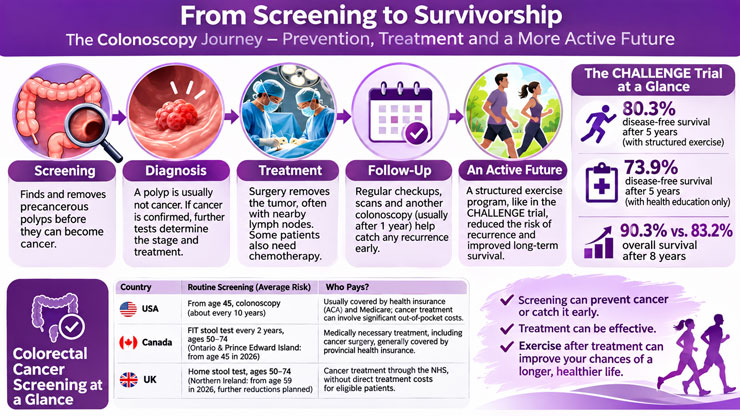
In the United States, colorectal cancer screening is recommended from age 45 for adults at average risk. A normal screening colonoscopy is generally repeated every ten years until age 75, with individualized decisions afterward. In Canada, most provinces recommend a fecal immunochemical test (FIT) every two years from ages 50 to 74, although Ontario and Prince Edward Island lowered their starting age to 45 in 2026. In Britain, routine screening also generally begins with a home stool test rather than an immediate colonoscopy. England, Scotland and Wales offer screening from ages 50 to 74, while Northern Ireland began expanding eligibility to 59-year-olds in November 2026, with further reductions planned.
People with certain family histories, hereditary conditions, previous polyps or concerning symptoms may need earlier or more frequent examinations. Colonoscopy offers an advantage that stool tests cannot: doctors can identify and remove precancerous polyps during the same procedure. Not every polyp becomes malignant, and not every colorectal cancer can be prevented, but removing potentially dangerous growths can interrupt the development of cancer before it begins. Screening is therefore not merely about finding cancer early. It can sometimes prevent cancer from developing at all.
The Cheapest Cancer Treatment May Be the One You Never Need
There is also an unmistakably American dimension to colorectal cancer prevention: money. Most Affordable Care Act-compliant private health insurance plans cover recommended preventive colonoscopies without patient cost-sharing when applicable network requirements are met. Removing a polyp during a covered screening procedure is generally included. Medicare also covers screening colonoscopies, although beneficiaries may owe a 15 percent coinsurance when a polyp is removed.
Once cancer is diagnosed, however, the financial picture can change dramatically. Surgery, chemotherapy, hospital stays, imaging and follow-up appointments may involve deductibles, coinsurance and other expenses even for insured patients. Without insurance, the burden can be far greater. The most expensive part of a colonoscopy should be your dignity, not your medical bills. Spending an evening within sprinting distance of the bathroom is unpleasant. Facing cancer treatment and a mountain of medical expenses is considerably worse.
Three Countries, Three Healthcare Systems — One Cancer Nobody Wants
In the United States, a cancer diagnosis can become a financial crisis even for someone with health insurance. Across the border in Canada, medically necessary hospital treatment and physician services are generally covered by provincial health insurance. In Britain, eligible patients receive cancer surgery and hospital treatment through the National Health Service without the American-style hospital bills. But there is another important difference: while Americans can choose a screening colonoscopy at regular intervals,
Canada and Britain generally begin routine screening with a simple stool test. A positive result may lead to colonoscopy, where suspicious polyps can often be removed before they become cancerous. The financial consequences differ dramatically between countries, but the medical lesson remains the same: finding a precancerous polyp is infinitely preferable to discovering an advanced tumor. The American patient may fear the hospital bill. The British or Canadian patient may worry about treatment delays or lost income. None of them wants to hear the word cancer.
A Positive Finding Does Not Automatically Mean Cancer
Before imagining the worst, an important distinction is necessary. Finding a polyp does not mean a patient has cancer. Many polyps are benign, while others contain precancerous changes that can be treated by removal. When a suspicious lesion is discovered, tissue examination determines whether malignant cells are present. If cancer is confirmed, additional investigations establish its location and extent. Imaging, laboratory tests and examination of the tumor help doctors determine the stage and select treatment. Some very early cancers can be removed endoscopically, while others require surgery. Treatment also differs between colon cancer and rectal cancer. A diagnosis is therefore the beginning of a detailed medical assessment, not an automatic sentence to chemotherapy or a permanent ostomy. The information gathered during staging determines what happens next.
After the Operation: Is the Cancer Really Gone?
For patients who require surgery, the affected section of bowel and nearby lymph nodes are commonly removed. The pathology report then provides crucial information about the tumor, its margins and whether cancer cells have reached the lymph nodes. Some patients with early-stage colon cancer need no chemotherapy after a successful operation. Others, particularly those with stage III disease or selected high-risk stage II tumors, may benefit from additional treatment. Recovery can involve fatigue, changes in bowel habits, reduced appetite and uncertainty about returning to normal activities. Not everyone needs a stoma, and when one is required it may be temporary or permanent depending on the circumstances. Even after apparently successful treatment, a difficult question remains: how can anyone be certain the cancer will not return? Unfortunately, no doctor can offer an absolute guarantee.
The Fear That Continues After Treatment
Finishing treatment does not necessarily mean finishing with cancer. Follow-up appointments can become emotionally demanding because every scan or blood test brings the possibility of unexpected news. Depending on the original stage, surveillance may include physical examinations, carcinoembryonic antigen blood tests and CT imaging. A colonoscopy is commonly recommended about one year after surgery, followed by another three years later and subsequently at approximately five-year intervals when results remain normal. These schedules are adjusted to individual circumstances. Patients may also face lasting changes in digestion, physical endurance and everyday confidence. The psychological challenge is real: a person can be medically free of detectable cancer while still worrying about recurrence. This is where the discussion usually turns to nutrition, exercise and the possibility of influencing long-term outcomes.
The CHALLENGE Trial: Exercise Changes the Conversation
In 2025, researchers published results that gave cancer survivors a scientifically grounded reason for cautious optimism. The international CHALLENGE trial, reported in the New England Journal of Medicine, enrolled 889 patients with surgically treated colon cancer who had completed adjuvant chemotherapy. Participants were randomly assigned either to a structured exercise program lasting three years or to a comparison group receiving health-education materials. The primary outcome was disease-free survival, which included cancer recurrence, new primary cancers or death. After five years, disease-free survival was 80.3 percent in the exercise group compared with 73.9 percent in the comparison group. That represents a difference of 6.4 percentage points. The findings from this randomized trial of exercise after colon cancer treatment were particularly important because they went beyond earlier observational evidence linking active lifestyles with better outcomes.
The Survival Numbers Are Even More Remarkable
The CHALLENGE researchers also reported eight-year overall survival of 90.3 percent in the exercise group compared with 83.2 percent among those receiving health education, a difference of 7.1 percentage points. These findings support a meaningful survival benefit, although they should not be presented as a guarantee for individual patients. The exercise intervention was not a casual recommendation to take occasional walks. It involved a structured, progressive program supported by trained professionals over several years. Musculoskeletal adverse events were also more common among participants assigned to exercise, emphasizing the importance of appropriate supervision and individual adaptation. Crucially, the trial involved a specific population of patients with colon cancer after surgery and chemotherapy. Its results cannot automatically be transferred to every cancer type, disease stage or treatment situation.
What Kind of Exercise Should Survivors Actually Do?
The evidence does not suggest that patients should leave the hospital and immediately begin strenuous training. Recovery, surgical complications, chemotherapy-related fatigue, neuropathy and other medical conditions may limit what is appropriate. Exercise should begin or progress with clearance and guidance from the treating team. Walking, cycling and other aerobic activities can help rebuild endurance, while appropriately selected resistance exercises support muscle strength and everyday function. The CHALLENGE program emphasized sustained behavioral change rather than one heroic workout. That distinction is essential. Exercise is not a replacement for surgery, chemotherapy or medical surveillance. It may become an additional part of survivorship care, alongside established treatment and follow-up. Our Fitness.com article Exercise as a Longevity Drug: Is It Still Better Than Anything in a Bottle? examines the broader scientific evidence for physical activity as a powerful preventive health measure.
Why Germany Keeps Reminding People About Colon Cancer
In Germany, the Felix Burda Foundation has spent decades encouraging people to participate in colorectal cancer screening. Its annual Colorectal Cancer Awareness Month in March began in 2002 and marked its twenty-fifth edition in 2026. The campaign repeatedly emphasizes a simple message: prevention and early detection are far preferable to confronting advanced disease. Germany generally offers statutory screening colonoscopy to women and men from age 50, with a ten-year interval after a normal examination.
The American recommendation begins earlier, at age 45 for average-risk adults, while Canadian and British screening programs predominantly rely on regular home stool tests. Despite differences between healthcare systems, the central message is identical. Embarrassment, inconvenience and dislike of bowel preparation are poor reasons to avoid a medically recommended examination. A few uncomfortable hours can be a reasonable investment in avoiding years of medical uncertainty.
Prevention First, Recovery Second, Hope Beyond Treatment
The ideal outcome of a colonoscopy is reassuringly uneventful: perhaps a polyp is removed, perhaps nothing is found, and life continues. When cancer is discovered, however, the story becomes more complicated. Surgery may remove the tumor, additional treatment may reduce the risk of recurrence, and regular surveillance becomes part of life. The CHALLENGE trial adds something important to that difficult journey: evidence that structured physical activity can improve outcomes for selected patients after treatment. It does not promise a cure or eliminate the fear of recurrence, but it offers a meaningful opportunity to participate actively in recovery. The lesson begins long before diagnosis. Accept the screening invitation, complete the recommended stool test or tolerate the miserable colonoscopy preparation when an examination is indicated, and let the medical team look for trouble before trouble finds you. If cancer has already entered your life, remember that treatment does not necessarily mark the end of what you can do for your future.
Scientific Sources
Courneya KS, et al. Structured Exercise after Adjuvant Chemotherapy for Colon Cancer. New England Journal of Medicine. 2025;393:13–25. DOI: 10.1056/NEJMoa2502760. US Preventive Services Task Force. Screening for Colorectal Cancer: US Preventive Services Task Force Recommendation Statement. JAMA. 2021;325:1965–1977. American Society of Colon and Rectal Surgeons. Clinical Practice Guidelines for Surveillance and Survivorship Care After Curative Treatment of Colon and Rectal Cancer. 2026. Centers for Medicare and Medicaid Services. Medicare Coverage of Screening Colonoscopies. US Department of Labor. Affordable Care Act Implementation FAQs, Parts XII and 51. Canadian Partnership Against Cancer. Colorectal Screening in Canada: Provincial and Territorial Screening Parameters. 2026. Ontario Health. ColonCancerCheck: Colorectal Cancer Screening Recommendations. 2026. NHS England. Bowel Cancer Screening Programme. 2026. NHS Inform Scotland. Bowel Screening. Public Health Agency Northern Ireland. Bowel Cancer Screening Age Extension. November 2026. Felix Burda Foundation. Colorectal Cancer Awareness Month, March 2026.
0 Comments
Log in to join the discussion.