Is the "plateau" a myth?

I've seen Steve say that it's 100% math. The number of calories you eat MINUS the number of calories you burn will determine if you loose/gain weight. Which TOTALLY makes logical sense.

BUT

I've heard about the plateau quite a lot from different people in this forum and even in a "Lifetime Fitness" class I took last summer. So what's the deal with this? Could it be that people are in denial and eating-more/exercising-less and they think they are aren't? Or is it that your body gets used to it?

Like I said what Steve comments a lot makes perfect logical sense, BUT your body getting used to the same too. I'd like to hear your thoughts. Thanks.
 
Your body doesn't always listen to what 'the numbers' say. And many of us on this forum are proof that plateaus actually happen.
 
If your body gets under stress (lack of food, etc), it may slow down its metabolism. It really is like a self defense mechanism your body triggers, trying to protect you.
 
I have probably talked more about plateaus than calories on the forum. They are real. Very real. Our bodies are very adaptive.
 
I will also add, more often than not, I find that people are not REALLY on a plateau. They usually are not being as strict with their nutrition as they need to be.

However, if you are really on a plateau, it takes some manipulation of your calories to "reset" some physiological systems. How you manipulate your calories depends completely on your individual circumstances, but most of the time it relates to eating maintenance calories for a period of time. And jumping right into maintenance intake is not always the right answer either.
 
I will also add, more often than not, I find that people are not REALLY on a plateau. They usually are not being as strict with their nutrition as they need to be.

I think Steve is spot on here.

I started increasing my calories because they were too low - I was still losing weight, but minimally & slowly - I was ok with that. Then, as I continued to up my calories, my weight loss stopped. Then eventually started gaining.

That stop in weightloss wasn't a plateau, but I could see where many people would think so - rather - it was the simple fact that I had probably hit my maintenance level and then started exceeding it.

I think it's pretty easy to assume that a stall in weightloss is a plateau, but I wonder how often it's because we're just not being as accurate as we could be with counting calories.
 
I know that I had a legit plateau a couple of weeks ago but I think it was a PMS. I was quite late with my cycle and my body just wasn't releasing anything. I did up my calories a bit and that helped temporarily but unfortanatly, that wieght did not stay off for more than a couple of days. Once I finally started my cycle however, it started to come off again and it's staying off.

I also know that my mother, who was very strict with her diet and under a doctors care for type 2 diabetes at the time, plateaued a few times when she lost her wieght so I know they do happen. She did however reach her goal eventually. :)
 
Do plateaus happen to everyone? I absolutely would hate to reach a plateau, but I am scared that I will soon since I have lost a relatively significant amount of weight. Is there an average of percentage of body weight a person loses before their body reaches the point of a plateau?
 
I'm not entirely sure what you mean by that linearly but when a woman has PMS, she will often not release any water weight and get bloated, I think that was more my problem then not losing the fat. I was hanging on to excess water weight.
 
I'm not entirely sure what you mean by that linearly but when a woman has PMS, she will often not release any water weight and get bloated, I think that was more my problem then not losing the fat. I was hanging on to excess water weight.

Yes, I know this. My comment was not so much directed toward you.... more the thread in general. :)
 
Ah okay, I wasn't sure.

Somethingnew, I wouldn't worry about it too much. If you do get one and you are doing everything right, they don't last, they're just a temporary part of weight loss for some people. :)
 
Ah okay, I wasn't sure.

Somethingnew, I wouldn't worry about it too much. If you do get one and you are doing everything right, they don't last, they're just a temporary part of weight loss for some people. :)

This depends. Some plateaus must be corrected before further weight will be lost. That is, unless you plan on reducing calories beyond a healthy lower limit, which would never be wise.

What I mean is, once some physiological adaptations to dieting take place, such as shifts in certain hormones (leptin, gherlin, peptide YY to name a few) you must counteract the shift by manipulating energy intake.

But you are right. For some, waiting it out a few weeks will do since, again, fat loss does not always happen in a linear fashion.

Metabolic slowdowns are an inevitable part of dieting. The severity of the slowdown depends mainly on how sensible you are with your approach. However, even a perfectly structured diet will lead to metabolic slowdown.

The more weight you have to lose, the less concerned you have to be.
 
Do plateaus happen to everyone? I absolutely would hate to reach a plateau, but I am scared that I will soon since I have lost a relatively significant amount of weight. Is there an average of percentage of body weight a person loses before their body reaches the point of a plateau?
No, they may not happen to everyone, they did not happen to me. I have lost 150lbs and never hit a plateau. I had weeks when I lost more and weeks when I lost less, but it never stopped.
 
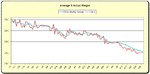
I have had two plateaus since January, each lasting over a month. And this happened while I was doing everything "right". Here's what they look like:

View attachment 3241

Eventually, I broke through each one by building up an accumulated deficit of well over 10,000 calories.
 

Attachments

  • weightgraph.jpg
    weightgraph.jpg
    69.7 KB · Views: 91
This will work if you are still carrying around a good bit of fat. But when you are relatively lean already, and looking to get leaner, the playing field changes.
 
Back
Top