

Sandra Olivia
New member
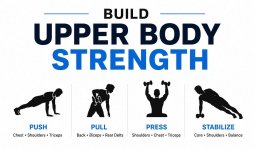
Does getting up from the floor feel harder than it used to? This could be why.
It's not just your legs. There's a specific type of upper body strength that most people aren't training. Without it, it can make pushing up from the ground a lot harder.
Most people think push-ups can only be done from the floor. But that can be a really difficult starting point for a lot of people.
Today, we are going to go step by step on how to build this vital arm strength, starting at a point that gets skipped a lot. The best part, it only takes a few minutes and you can easily do this at home.
 Step One: Wall Push-Up
- Step one is a wall push-up and where everyone should start.
- You'll need blank space on a wall. Stand about an arm’s length away. Hands are at shoulder height. Elbows are straight and feet are directly underneath you.
- From here, bring your forehead close to the wall and then press away. Bring your forehead towards the wall and press away.
- As you do this, you should be feeling it in the backs of your arms and in your chest muscles.
- Keep your body in a straight line. Imagine there's a pole connected to the top of your head down to the bottom of your heel. Your body moves as one.
- Keep your elbows in close. They don't have to be glued to your sides, but don't let your elbows come out to the side.
- You're aiming for 10 to 15 repetitions here. If this starts to feel easy, you can move on to step two.
2.  Step Two: Kitchen Counter Push-Up
In step two, move to a lower surface like a kitchen counter. You can also use the edge of a couch or something stable that is not going to move.
Stand about an arm’s length away and take about a half step back so your body is in a subtle diagonal.
Bring your chest towards the counter and then push away.
As you move to a lower surface, your muscles have to work harder. Again, focus on the muscles in the backs of the arms and in the chest.
Keep your elbows in close, stay in control, and keep your body in a straight line.
Focus on full range of motion. Bring your chest all the way down and back up.
We're looking for about 10 to 15 repetitions here.
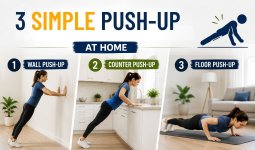
3. Step Three: Floor Push-Up
Step three is moving even lower or eventually to the floor.
Set yourself up in a plank position. Hands underneath your shoulders. Body is in a nice straight line.
Bring your chest down to the surface and then press up.
A lot of people shorten the movement and don't go all the way down. That minimizes the benefit of this exercise.
Some also allow their hips to sag down, which takes the core control out of this movement and puts more stress on the shoulders and back.
Keep your body in a straight line and maintain full range of motion coming all the way down and up.
Aim for eight to 15 repetitions here.
If you're dealing with wrist pain, holding on to weights can help keep your wrist in a more neutral position.
Keep your elbows in close and do not let them flare out to the side.
Why Upper Body Strength Matters
This is the type of strength that makes getting up from the floor, picking up grandchildren, and carrying heavy groceries much easier.
Upper body strength can also help with getting out of bed, standing up from a chair, and getting out of the car.
You cannot neglect upper body strength.
Start with the step that seems most doable to you right now. Consistently working at this two or three times a week can be a great place to start. Once one step starts to feel easy, move on to the next.
Strong arms, strong core, and controlled movement can help you feel strong while keeping your joints happy too.