Eat more seafood

Status
Not open for further replies.

nasir017

New member
Eating oysters, crab, salmon, and tuna, and other copper-rich foods like beef and brazil nuts can help you lose fat by improving your fat cells’ ability to regulate metabolic processes, according to a study by Johns Hopkins University in the US. Subjects suffering from low copper levels had “fatter” fat cells, the researchers found, because the deficiency altered how these cells process the storage and burning of fatty acids and sugars.
 
Hey Nasir, good post, I love seafood. Brazil nuts not so much.

Tell us about yourself and your goals. Starting a diary would be a good thing to think about.
 
I would encourage eating a variety of foods rich in micronutrients as a focus for weight loss. Foods that are nutrient dense and low calorie are always a popular choice for me. Eating enough calories with these types of foods will lead to sustained weight loss over time.

It is easy to criticize or glorify a single nutrient. As a society, we tend to want to have a defined cause for a specific event. Example: copper deficiency leads to higher fat storage. That may or may not be the cause, but we want to believe it so we can start "fixing" our problem. However, I believe that is the wrong way to do this. It doesnt address the root cause of excess fat storage you already have.

In case that doesnt suit you and you're adamant about getting more copper, try dark green leafy vegetables like kale, spinach, or swiss chard. Also, I believe most nuts have a significant source, not just Brazil. And give shitake mushrooms a review while you're at it.

Keep in mind, too much of anything can be harmful. It's a balance of ratios. Eating a diverse amount of low calorie, high nutrient foods will provide that balance by default. It takes the guess work and math out of it.
 
Hello, IV! Nice to hear a good word for the dark green leafy vegies - though I've never quite gone for kale, myself. :)
 
Hi aminglow,

I am an advocate for more plants in the diet. Dark green leafy vegetables are among the most nutritious and low calorie food we have in this world.

Kale might not suit you (or others), but there are quite a few options to choose from. Swiss chard, turnip greens, and spinach are somewhat easy to find depending where you are (frozen is totally acceptable). Fresh and dried herbs count too, like oregano, basil, and thyme to name a few. Some are more accessible and/or less expensive than others, but they all provide an impressive amount of nutrients, especially for the low calories they contain.
 
i am a big advocate of the "on sale" diet...

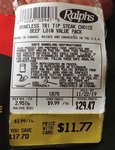
tri tip.jpg

serious.y... fish? a few decades ago i could buy any fish for a few $/lb.
the other day i saw swordfish (if that WAS swordfish) at > $20/lb.

the other problem with seafood... bigger fish eat smaller fish... a number of times.
every time this happens, the toxic substances they ingest are increased.
cattle and sheep eat grain and grass.

Go Canada...!
 
I'm not sure about Canada, but in the USA, cattle are processed so quickly that cleanliness becomes an issue. The label you have even warns of it. It may have "passed meat and/or poultry..." (they processed that label so fast they couldn't finish thier sentence), but it goes on to warn of "bacteria that could cause illness".

You might not know, but most cattle are given a $50 or so medical cap. If thier treatment for illness breaches that sum, the cattle is left to fend for survival without medical help. As you can imagine, this means a lot of cattle would die due to disease. Dont worry, that would be too expensive for the cattle industry to handle. They are instead fed food loaded with antibiotics, so as to prevent illness in the first place. The problem is evolution. Bacteria reproduce at an exponential rate, giving rise to antibiotic resistant organisms (superbugs). You, the consumer, will inevitably contract a superbug and have to seek medical treatment (hopefully with a budget higher than $50).

So, how much did that doctor visit cost? In the US, could be quite a bit of money. Certainly more than the $17.70 you saved by buying the beef to begin with.

Also, it was raised in the USA which means grass (laughs) and grain (corn - not the standard diet for a cow - causes bacterial problems in the cow's gut) are not necessarily the only thing being fed to the cow. Go USA!

If this causes an emotional response, I'd first like to ask for you to verify or refute what I've said with cited sources. It's easy to be passionate about a belief, but remember what your goals are. I'm only trying to help. The best way to do that is to get a better understanding of the food you eat.

And specifically for overlandflyer, I know food budgets can be tight. Beans and whole grain rice are some of the least expensive and most nutritious foods available to us first worlders. The third worlds eat these in spades. Their track record for food caused diseases such as hypertension, coronary artery disease, and obesity are incredibly low until they start eating like us.

 
.... The label you have even warns of it. It may have "passed meat and/or poultry..." (they processed that label so fast they couldn't finish thier sentence), but it goes on ....

"This product was prepared from inspected and passed meat and/or poultry."

i suppose i could take exception to the "and/". i've never seen poultry packaged with another meat, but i guess they're just covering all bases. other than that, it looks grammatically correct to me. this is essentially all legal stuff. it protects the store from being sued. thanks, lawyers. it has little to do with a health warning.

since they have been follow-up visits, the last few medical appts have had no co-pay. two of them were CAT-scans. i'm going in for my annual medical next week. i'm pretty sure that will be ~$20. last year i was 6', 192lbs in November... this year i'm 5' 11¼, 165 lbs. he'll probably be happier.

i don't eat beef every day... i don't drink beer every day... i don't take vitamins or supplements any day... i just got another pneumonia shot, but i've never had a flu shot... i had measles mumps & chickenpox when i was a kid... i have four separate hunks of metal in my body... i don't worry about eating GMO's or ARO's. white blood cells are still doing their job. you ought to put more faith in your body... it's more resilient than most people think if you don't abuse it too much.

spend your day enjoying life for a change.
that's the healthiest thing i could recommend
you really do seem to worry too much.
 
i am a big advocate of the "on sale" diet...

I am also somewhat a fan of this as well, but economically, I find buying a full side of local beef to be very economical, I don't have the freezer space for a full cow. I am also rather partial to goat meat, the mobile butcher is great for those of us who could do with a bit more skill in the butchering process. With fish I rather like mullet, leatherjacket, or a nice big fresh caught flathead. Yabbies can also be good eating but we don't have any in our dams.
 
except for staples (lemon juice, coffee, tea, etc) i have given up creating a meal shopping list when i go to Ralph's. i start with whatever is on sale or in season and just wing it from there. unfortunately these days there is little chance of finding a deal on fish and many times the deals are from suspicious origin "farmed" fish. on the upside, it's a few miles to the docks and if i want something fresh, i'll get on a 3/4 day boat and throw a hook in the water for the afternoon.
 
That's an incredible achievement! I know you must be happy about it. That kind of weight loss is hard to accomplish for most people. It requires dedication. For your reported height and weight, the BMI charts have you in the normal or healthy category. That's cause for celebration.

I wonder if you are ready to look at health beyond the issues of fat storage. It would be interesting to see what you could find out about the nutrition of one of your favorite foods.

Example:
The picture describes a slice of cow. What nutrients can be found in a representative serving of that food? If there is a nutrition label, you might be halfway there. But then find out where those nutrients came from. How did the cow get those nutrients (beyond the obvious, "it ate it")? What do those nutrients do in your body? What is thier purpose?

The more research and thought you put into this excercise, the more enriched your trip to health will be. Remember to use sources you trust or find credible. Unfortunately, there is a lot of information out there that may have been distorted for one reason or another. Consider who is telling you this information and ask if they have a financial reason to sway you.

Congratulations on the achievement.
 
Status
Not open for further replies.
Back
Top